

From carbon source to carbon sink: Influences of magmatism and erosion in continental arcs on long-term carbon cycle
-
摘要:
在百万年时间尺度上, 大气、海洋中的二氧化碳浓度(PCO2, 二氧化碳分压)和长期变化主要受岩浆-变质脱碳作用和硅酸盐风化作用(消耗二氧化碳)控制。因此, 地球表层主要构造活动带的构造-岩浆活动对长期碳循环具有重要的驱动作用。本文在总结已发表文献的基础上, 系统评估了大陆弧, 尤其是晚白垩世大陆弧的岩浆作用和剥蚀作用的碳通量, 并以此为依据探讨了大陆弧演化对于全球长期碳循环的影响。大陆弧岩浆作用以周期性(几十到几百百万年)岩浆爆发(magmatic flare-ups)为特征。在一个周期内, 大规模岩浆喷发会导致CO2排放量大幅度增加, 促进温室效应。但同时, 大规模的岩浆作用又会导致地壳增厚和和地表抬升, 从而促进剥蚀作用、提高化学风化通量, 进而增加CO2消耗量。对于单个的大陆弧来说, 在其演化的不同阶段对于碳循环扮演着不同的角色: 演化早期由于岩浆作用起主导作用, 表现为净碳源; 而在岩浆作用减弱或停止后, 由于剥蚀作用的持续进行, 表现为净碳汇。因此, 从长周期和全球尺度上讲, 大陆弧岩浆活动表现的"碳源属性"受到化学风化作用表现的"碳汇属性"的调节, 使得地球环境在长期的地质演化过程中维系宜居性。
Abstract:On multimillion-year time scales, the long-term stability of atmospheric-oceanic PCO2 is dominantly determined by the balance between the rate of CO2 input from magmatic/metamorphic degassing and the efficiency of CO2 uptake by silicate weathering. Continental arcs are characterized by episodic voluminous magmatic flare-ups in the time scale of tens to hundreds of millions of years. Flare-ups in continental arc result in increasing CO2 outgassing, which enhances CO2 concentration in the atmosphere and greenhouse climate. However, development of continental magmatic arc often accompanies with rapid arc unroofing and erosion due to magmatic/tectonic thickening of the crust, thus also enhances the chemical weathering flux, which in turn increases the CO2 sink. With the coupled magmatism and erosion processes in continental arcs, during the rise and fall and continental arcs, regionally the arc serves as either a carbon source or sink depending on the stage of the arc life. The development of continental arcs increases weatherability through mountain building processes, and therefore may increase the strength of the global negative feedback between silicate weathering and climate. In this way continental arcs play an important role in sustaining the Earth habitability.
-
Key words:
- Continental arc /
- Magmatism /
- Erosion /
- Carbon source /
- Carbon sink /
- Carbon cycle
-

-
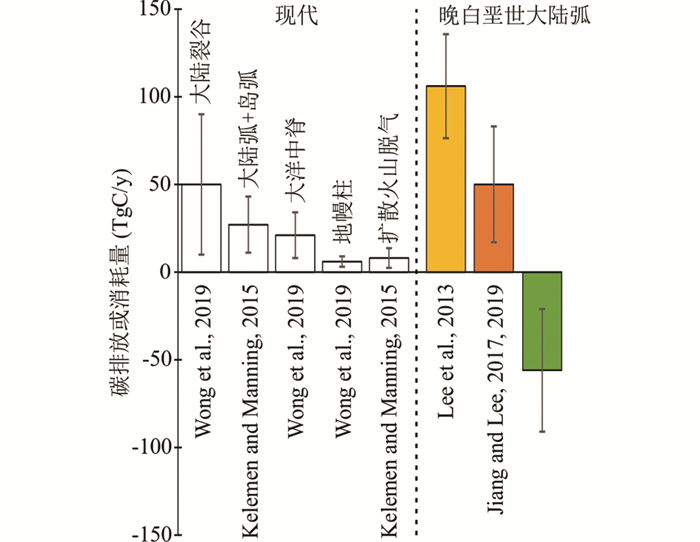
图 1
全球现代主要构造活动带火山脱气排碳量及其与晚白垩世大陆弧碳排放和碳消耗量的对比
Figure 1.
CO2 sources and fluxes at present time, compared with CO2 outgassing and consumption from and by continental arcs in Late Cretaceous

图 2
近400百万年间大气CO2、全球大陆弧长度、海水Sr同位素和碎屑锆石年龄变化趋势(据Gernon et al., 2021修改)
Figure 2.
Atmospheric CO2, continental arc length, seawater Sr isotopes, and detrital zircon age changes over the past 400Ma(modified after Gernon et al., 2021)

图 3
大陆弧演化过程中的岩浆作用和剥蚀作用及其所引起的碳排放和碳消耗示意图
Figure 3.
Schematic diagram showing major processes during development of continental arcs
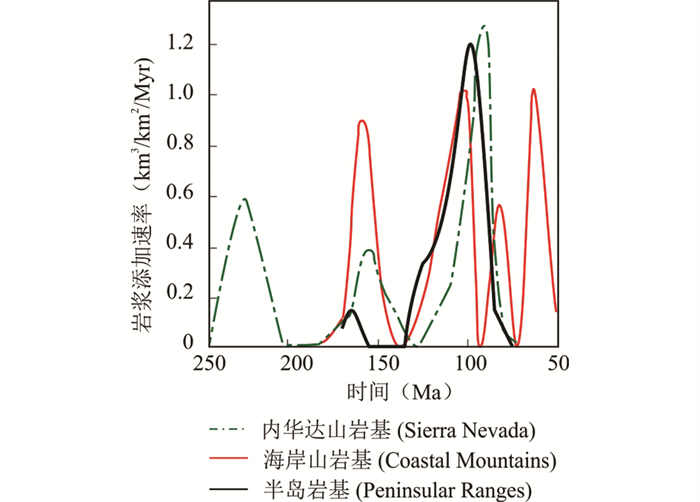
图 4
中生代-早新生代北美科迪勒拉弧的岩浆爆发历史
Figure 4.
Magmatic flare-up histories of the North American Cordilleran arc segments
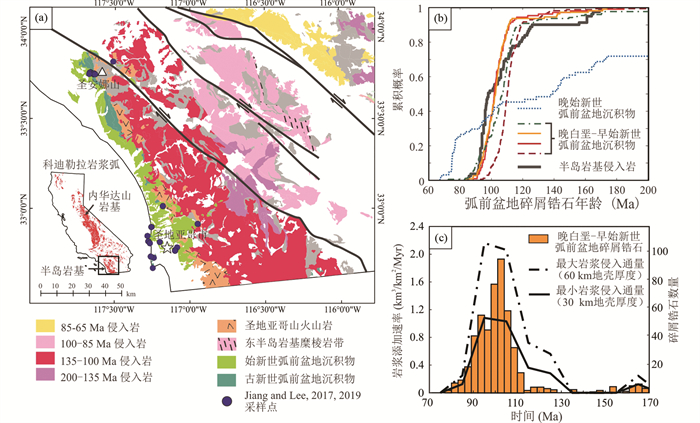
图 5
美国加利福尼亚州半岛岩基及其相关弧前盆地沉积物地质背景(据Jiang and Lee, 2017, 2019修改)
Figure 5.
Geological setting for the Peninsular Ranges batholith and the associated forearc basin in southern California, USA (details see Jiang and Lee, 2017, 2019)

图 6
半岛岩基晚白垩世-早始新世岩浆添加速率、剥蚀速率、地壳厚度和海拔高度演化历史
Figure 6.
Data and mass balance and isostatic model results for instantaneous erosion rates, excess crustal thickness, and elevation evolution in the Peninsular Ranges batholith continental arc
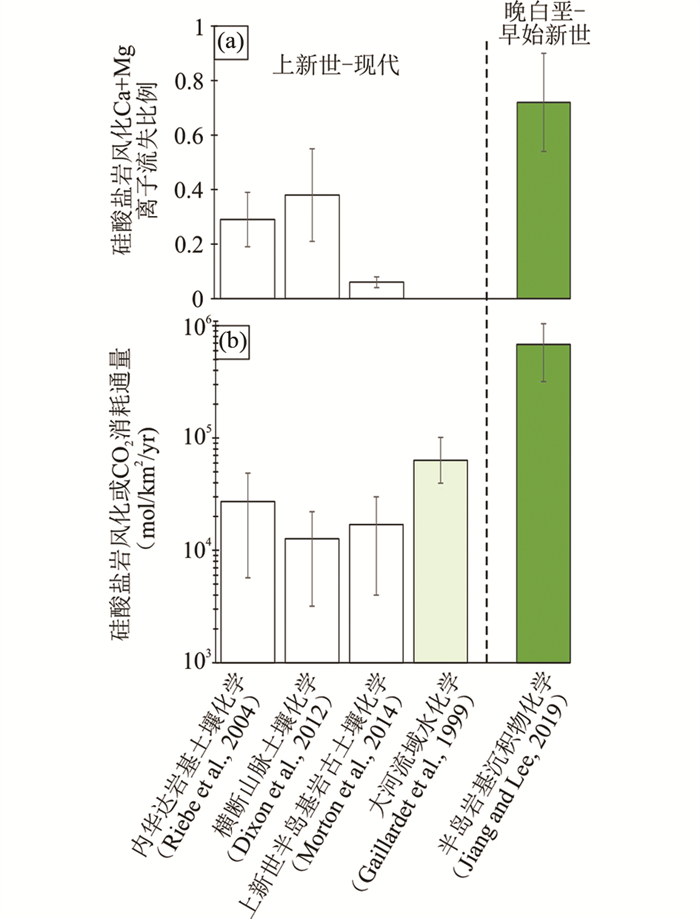
图 7
晚白垩-早始新世半岛岩基在风化剥蚀过程中Ca、Mg离子的流失比例和硅酸盐风化通量(或CO2消耗通量)以及与上新世-现代北美科迪勒拉弧以及现代全球大陆风化相关数据的对比
Figure 7.
Chemical depletion fraction of Ca+Mg and silicate weathering flux (in CO2 equivalent) in the Late Cretaceous-Early Eocene Peninsular Ranges batholith (Jiang and Lee, 2019), compared to Pliocene-modern quantities
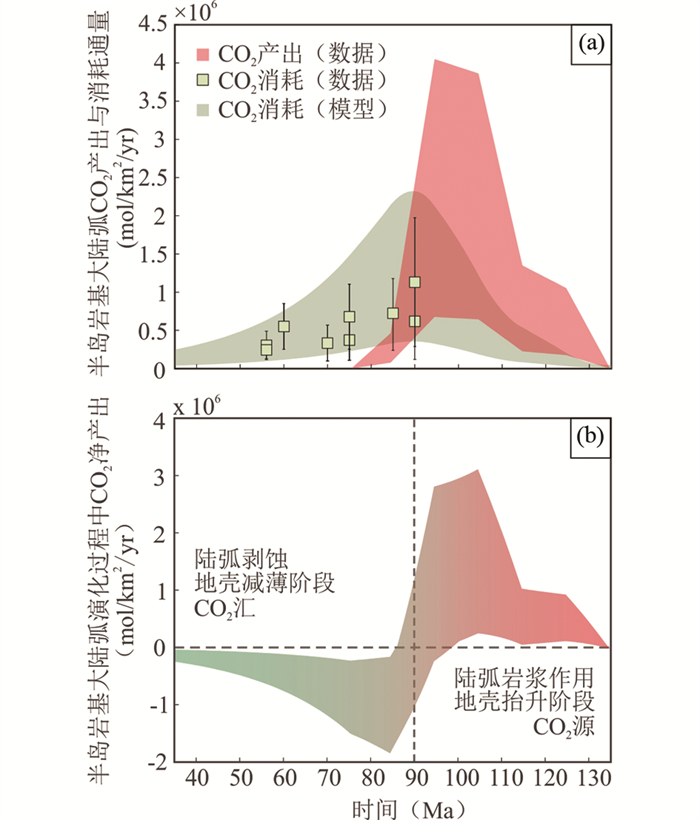
图 8
半岛岩基中CO2生产和消耗通量(a)以及净CO2通量(b)随时间的变化(据Jiang and Lee, 2019修改)
Figure 8.
Variation in CO2 production and consumption (a), and net CO2 fluxes (b) in the Cretaceous-Eocene Peninsular Ranges continental arc (modified after Jiang and Lee, 2019)
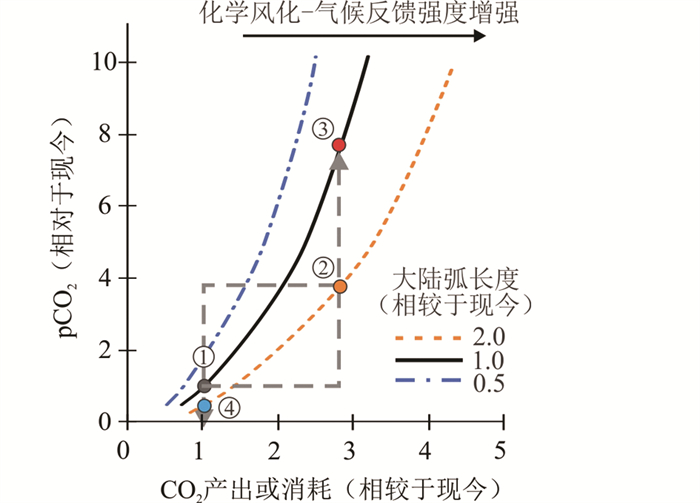
图 9
大陆弧演化对全球碳循环的影响的半定量化示意图(据Jiang and Lee, 2019修改)
Figure 9.
Semi-quantitative diagram showing different stabilized PCO2 levels depending on CO2 production and silicate weathering-climate feedback strength (modified after Jiang and Lee, 2019)
-
Ague JJ and Nicolescu S. 2014. Carbon dioxide released from subduction zones by fluid-mediated reactions. Nature Geoscience, 7(5): 355-360 doi: 10.1038/ngeo2143
Becker JA, Bickle MJ, Galy A and Holland TJB. 2008. Himalayan metamorphic CO2 fluxes: Quantitative constraints from hydrothermal springs. Earth and Planetary Science Letters, 265(3-4): 616-629 doi: 10.1016/j.epsl.2007.10.046
Berner RA, Lasaga AC and Garrels RM. 1983. The carbonate-silicate geochemical cycle and its effect on atmospheric carbon dioxide over the past 100 million years. American Journal of Science, 283(7): 641-683 doi: 10.2475/ajs.283.7.641
Berner RA. 1991. A model for atmospheric CO2 over Phanerozoic time. American Journal of Science, 291(4): 339-376 doi: 10.2475/ajs.291.4.339
Berner RA. 1992. Weathering, plants, and the long-term carbon cycle. Geochimica et Cosmochimica Acta, 56(8): 3225-3231 doi: 10.1016/0016-7037(92)90300-8
Brady PV. 1991. The effect of silicate weathering on global temperature and atmospheric CO2. Journal of Geophysical Research, 96(B11): 18101-18106 doi: 10.1029/91JB01898
Cao WR and Paterson S. 2016. A mass balance and isostasy model: Exploring the interplay between magmatism, deformation and surface erosion in continental arcs using central Sierra Nevada as a case study. Geochemistry, Geophysics, Geosystems, 17(6): 2194-2212 doi: 10.1002/2015GC006229
Cao WR, Lee CTA and Lackey JS. 2017. Episodic nature of continental arc activity since 750Ma: A global compilation. Earth and Planetary Science Letters, 461: 85-95 doi: 10.1016/j.epsl.2016.12.044
Carter LB and Dasgupta R. 2016. Effect of melt composition on crustal carbonate assimilation: Implications for the transition from calcite consumption to skarnification and associated CO2 degassing. Geochemistry, Geophysics, Geosystems, 17(10): 3893-3916 doi: 10.1002/2016GC006444
Carter LB and Dasgupta R. 2018. Decarbonation in the Ca-Mg-Fe carbonate system at mid-crustal pressure as a function of temperature and assimilation with arc magmas: Implications for long-term climate. Chemical Geology, 492: 30-48 doi: 10.1016/j.chemgeo.2018.05.024
Caves JK, Jost AB, Lau KV and Maher K. 2016. Cenozoic carbon cycle imbalances and a variable weathering feedback. Earth and Planetary Science Letters, 450: 152-163 doi: 10.1016/j.epsl.2016.06.035
Chu X, Lee CTA, Dasgupta R and Cao WR. 2019. The contribution to exogenic CO2 by contact metamorphism at continental arcs: A coupled model of fluid flux and metamorphic decarbonation. American Journal of Science, 319(8): 631-657 doi: 10.2475/08.2019.01
Dasgupta R and Hirschmann MM. 2010. The deep carbon cycle and melting in Earth's interior. Earth and Planetary Science Letters, 298(1-2): 1-13 doi: 10.1016/j.epsl.2010.06.039
DeCelles PG, Ducea MN, Kapp P and Zandt G. 2009. Cyclicity in Cordilleran orogenic systems. Nature Geoscience, 2(4): 251-257 doi: 10.1038/ngeo469
Dixon JL, Hartshorn AS, Heimsath AM, DiBiase RA and Whipple KX. 2012. Chemical weathering response to tectonic forcing: A soils perspective from the San Gabriel Mountains, California. Earth and Planetary Science Letters, 323-324: 40-49 doi: 10.1016/j.epsl.2012.01.010
Ducea M. 2001. The California arc: Thick granitic batholiths, eclogitic residues, lithospheric-scale thrusting, and magmatic flare-ups. GSA Today, 11(11): 4-10 doi: 10.1130/1052-5173(2001)011<0004:TCATGB>2.0.CO;2
Ducea MN and Barton MD. 2007. Igniting flare-up events in Cordilleran arcs. Geology, 35(11): 1047-1050 doi: 10.1130/G23898A.1
Fialko Y and Pearse J. 2012. Sombrero uplift above the Altiplano-Puna magma body: Evidence of a ballooning mid-crustal diapir. Science, 338(6104): 250-252 doi: 10.1126/science.1226358
Foster GL, Royer DL and Lunt DJ. 2017. Future climate forcing potentially without precedent in the last 420 million years. Nature Communications, 8: 14845 doi: 10.1038/ncomms14845
Gaillardet J, Dupré B, Louvat P and Allègre CJ. 1999. Global silicate weathering and CO2 consumption rates deduced from the chemistry of large rivers. Chemical Geology, 159(1-4): 3-30 doi: 10.1016/S0009-2541(99)00031-5
Gernon TM, Hincks TK, Merdith AS, Rohling EJ, Palmer MR, Foster GL, Bataille CP and Müller RD. 2021. Global chemical weathering dominated by continental arcs since the Mid-Palaeozoic. Nature Geoscience, 14: 690-696 doi: 10.1038/s41561-021-00806-0
Girty GH. 1987. Sandstone provenance, Point Loma Formation, San Diego, California: Evidence for uplift of the Peninsular Ranges during the Laramide Orogeny. Journal of Sedimentary Petrology, 57(5): 839-844
Girty GH, Gebhart KL, Replogle CT, Morton N, Purcell JW, Parizek JR, Carrasco T, Errthum R and Groover K. 2014. Reconstructing the regolith from erosionally exhumed corestone and saprock derived from the Cretaceous Val Verde tonalite, Peninsular Ranges, southern California, USA: A case study. Catena, 113: 150-164 doi: 10.1016/j.catena.2013.10.004
Haschke MR, Scheuber E, Günther A and Reutter KJ. 2002. Evolutionary cycles during the Andean orogeny: Repeated slab breakoff and flat subduction? Terra Nova, 14(1): 49-55 doi: 10.1046/j.1365-3121.2002.00387.x
Hilley GE, Chamberlain CP, Moon S, Porder S and Willett SD. 2010. Competition between erosion and reaction kinetics in controlling silicate-weathering rates. Earth and Planetary Science Letters, 293(1-2): 191-199 doi: 10.1016/j.epsl.2010.01.008
Holland HD. 1984. The Chemical Evolution of the Atmosphere and Oceans. Princeton: Princeton University Press
Iacono-Marziano G, Gaillard F, Scaillet B, Pichavant M and Chiodini G. 2009. Role of non-mantle CO2 in the dynamics of volcano degassing: The Mount Vesuvius example. Geology, 37(4): 319-322 doi: 10.1130/G25446A.1
Isson TT and Planavsky NJ. 2018. Reverse weathering as a long-term stabilizer of marine pH and planetary climate. Nature, 560(7719): 471-475 doi: 10.1038/s41586-018-0408-4
Jiang HH and Lee CTA. 2017. Coupled magmatism-erosion in continental arcs: Reconstructing the history of the Cretaceous Peninsular Ranges batholith, southern California through detrital hornblende barometry in forearc sediments. Earth and Planetary Science Letters, 472: 69-81 doi: 10.1016/j.epsl.2017.05.009
Jiang HH and Lee CTA. 2019. On the role of chemical weathering of continental arcs in long-term climate regulation: A case study of the Peninsular Ranges batholith, California (USA). Earth and Planetary Science Letters, 525: 115733 doi: 10.1016/j.epsl.2019.115733
Johnston FKB, Turchyn AV and Edmonds M. 2011. Decarbonation efficiency in subduction zones: Implications for warm Cretaceous climates. Earth and Planetary Science Letters, 303(1-2): 143-152 doi: 10.1016/j.epsl.2010.12.049
Kelemen PB and Manning CE. 2015. Reevaluating carbon fluxes in subduction zones, what goes down, mostly comes up. Proceedings of the National Academy of Sciences of the United States of America, 112(30): E3997-E4006
Kimbrough DL, Smith DP, Mahoney JB, Moore TE, Grove M, Gastil RG, Ortega-Rivera A and Fanning CM. 2001. Forearc-basin sedimentary response to rapid Late Cretaceous batholith emplacement in the Peninsular Ranges of southern and Baja California. Geology, 29(6): 491-494 doi: 10.1130/0091-7613(2001)029<0491:FBSRTR>2.0.CO;2
Kimbrough DL, Abbott PL, Balch DC, Bartling SH, Grove M, Mahoney JB, Donohue RF. 2014. Upper Jurassic Peñasquitos Formation: Forearc basin western wall rock of the Peninsular Ranges batholith. In: Morton DM and Miller FK (eds. ). Peninsular Ranges Batholith, Baja California and Southern California. Geological Society of America Memoirs, 211: 625-643
Kump LR, Brantley SL and Arthur MA. 2000. Chemical weathering, atmospheric CO2, and climate. Annual Review of Earth and Planetary Sciences, 28: 611-667 doi: 10.1146/annurev.earth.28.1.611
Lee CTA, Morton DM, Kistler RW and Baird AK. 2007. Petrology and tectonics of Phanerozoic continent formation: From island arcs to accretion and continental arc magmatism. Earth and Planetary Science Letters, 263(3-4): 370-387 doi: 10.1016/j.epsl.2007.09.025
Lee CTA, Shen B, Slotnick BS, Liao K, Dickens GR, Yokoyama Y, Lenardic A, Dasgupta R, Jellinek M, Lackey JS, Schneider T and Tice MM. 2013. Continental arc-island arc fluctuations, growth of crustal carbonates, and long-term climate change. Geosphere, 9(1): 21-36 doi: 10.1130/GES00822.1
Lee CTA and Lackey JS. 2015. Global continental arc flare-ups and their relation to long-term greenhouse conditions. Elements, 11(2): 125-130 doi: 10.2113/gselements.11.2.125
Lee CTA, Thurner S, Paterson S and Cao WR. 2015. The rise and fall of continental arcs: Interplays between magmatism, uplift, weathering, and climate. Earth and Planetary Science Letters, 425: 105-119 doi: 10.1016/j.epsl.2015.05.045
Lee CTA, Jiang HH, Ronay E, Minisini D, Stiles J and Neal M. 2018. Volcanic ash as a driver of enhanced organic carbon burial in the Cretaceous. Scientific Reports, 8: 4197 doi: 10.1038/s41598-018-22576-3
Lee CTA, Jiang HH, Dasgupta R and Torres M. 2019. A framework for understanding whole-earth carbon cycling. In: Orcutt BN, Daniel I and Dasgupta R (eds. ). Deep Carbon: Past to Present. Cambridge: Cambridge University Press, 313-357
Louvat P and Allègre CJ. 1997. Present denudation rates on the island of Réunion determined by river geochemistry: Basalt weathering and mass budget between chemical and mechanical erosions. Geochimica et Cosmochimica Acta, 61(17): 3645-3669 doi: 10.1016/S0016-7037(97)00180-4
Lowenstern JB. 2001. Carbon dioxide in magmas and implications for hydrothermal systems. Mineralium Deposita, 36(6): 490-502 doi: 10.1007/s001260100185
Maher K and Chamberlain CP. 2014. Hydrologic regulation of chemical weathering and the geologic carbon cycle. Science, 343(6178): 1502-1504 doi: 10.1126/science.1250770
Marty B and Tolstikhin IN. 1998. CO2 fluxes from mid-ocean ridges, arcs and plumes. Chemical Geology, 145(3-4): 233-248 doi: 10.1016/S0009-2541(97)00145-9
Mason E, Edmonds M and Turchyn AV. 2017. Remobilization of crustal carbon may dominate volcanic arc emissions. Science, 357(6348): 290-294 doi: 10.1126/science.aan5049
McKenzie NR, Horton BK, Loomis SE, Stockli DF, Planavsky NJ and Lee CTA. 2016. Continental arc volcanism as the principal driver of icehouse-greenhouse variability. Science, 352(6284): 444-447 doi: 10.1126/science.aad5787
McKenzie NR and Jiang HH. 2019. Earth's outgassing and climatic transitions: The slow burn towards environmental "catastrophes"? Elements, 15(5): 325-330 doi: 10.2138/gselements.15.5.325
Morton DM, Miller FK, Kistler RW, Premo WR, Lee CTA, Langenheim VE, Wooden JL, Snee LW, Clausen BL and Cossette P. 2014. Framework and petrogenesis of the northern Peninsular Ranges batholith, southern California. In: Morton DM and Miller FK (eds. ). Peninsular Ranges Batholith, Baja California and Southern California. Geological Society of America Memoirs, 211: 61-143
Paterson SR and Ducea MN. 2015. Arc magmatic tempos: Gathering the evidence. Elements, 11(2): 91-98 doi: 10.2113/gselements.11.2.91
Ramos EJ, Lackey JS, Barnes JD and Fulton AA. 2020. Remnants and rates of metamorphic decarbonation in continental arcs. GSA Today, 30(5): 4-10 doi: 10.1130/GSATG432A.1
Ratschbacher BC, Paterson SR and Fischer TP. 2019. Spatial and depth-dependent variations in magma volume addition and addition rates to continental arcs: Application to global CO2 fluxes since 750Ma. Geochemistry, Geophysics, Geosystems, 20(6): 2997-3018 doi: 10.1029/2018GC008031
Riebe CS, Kirchner JW and Finkel RC. 2004. Erosional and climatic effects on long-term chemical weathering rates in granitic landscapes spanning diverse climate regimes. Earth and Planetary Science Letters, 224(3-4): 547-562 doi: 10.1016/j.epsl.2004.05.019
Sano Y and Williams SN. 1996. Fluxes of mantle and subducted carbon along convergent plate boundaries. Geophysical Research Letters, 23(20): 2749-2752 doi: 10.1029/96GL02260
Schoellhamer JE. 1981. Geology of the Northern Santa Ana Mountains, California. Washington: United States Department of the Interior, Geological Survey, 109
Sharman GR, Graham SA, Grove M, Kimbrough DL and Wright JE. 2015. Detrital zircon provenance of the Late Cretaceous-Eocene California forearc: Influence of Laramide low-angle subduction on sediment dispersal and paleogeography. GSA Bulletin, 127(1-2): 38-60 doi: 10.1130/B31065.1
Tanner WF. 1962. Components of the hypsometric curve of the Earth. Journal of Geophysical Research, 67(7): 2841-2843 doi: 10.1029/JZ067i007p02841
Troll VR, Hilton DR, Jolis EM, Chadwick JP, Blythe LS, Deegan FM, Schwarzkopf LM and Zimmer M. 2012. Crustal CO2 liberation during the 2006 eruption and earthquake events at Merapi volcano, Indonesia. Geophysical Research Letters, 39(11): L11302
van der Meer DG, Zeebe RE, van Hinsbergen DJJ, Sluijs A, Spakman W and Torsvik TH. 2014. Plate tectonic controls on atmospheric CO2 levels since the Triassic. Proceedings of the National Academy of Sciences of the United States of America, 111(12): 4380-4385 doi: 10.1073/pnas.1315657111
Veizer J, Ala D, Azmy K, Bruckschen P, Buhl D, Bruhn F, Carden GAF, Diener A, Ebneth S, Godderis Y, Jasper T, Korte C, Pawellek F, Podlaha OG and Strauss H. 1999. 87Sr/86Sr, δ13C and δ18O evolution of Phanerozoic seawater. Chemical Geology, 161(1-3): 59-88 doi: 10.1016/S0009-2541(99)00081-9
Voice PJ, Kowalewski M and Eriksson KA. 2011. Quantifying the timing and rate of crustal evolution: Global compilation of radiometrically dated detrital zircon grains. The Journal of Geology, 119(2): 109-126 doi: 10.1086/658295
Walker JCG, Hays PB and Kasting JF. 1981. A negative feedback mechanism for the long-term stabilization of Earth's surface temperature. Journal of Geophysical Research, 86(C10): 9776-9782 doi: 10.1029/JC086iC10p09776
Ward KM, Zandt G, Beck SL, Christensen DH and McFarlin H. 2014. Seismic imaging of the magmatic underpinnings beneath the Altiplano-Puna volcanic complex from the joint inversion of surface wave dispersion and receiver functions. Earth and Planetary Science Letters, 404: 43-53 doi: 10.1016/j.epsl.2014.07.022
Werner C, Fischer TP, Aiuppa A, Edmonds M, Cardellini C, Carn S, Chiodini G, Cottrell E, Burton M, Shinohara H and Allard P. 2019. Carbon dioxide emissions from subaerial volcanic regions: Two decades in review. In: Orcutt BN, Daniel I and Dasgupta R (eds. ). Deep Carbon: Past to Present. Cambridge: Cambridge University Press, 188-236
West AJ, BIckle MJ, Collins R and Brasington J. 2002. Small-catchment perspective on Himalayan weathering fluxes. Geology, 30(4): 355-358 doi: 10.1130/0091-7613(2002)030<0355:SCPOHW>2.0.CO;2
West AJ, Galy A and Bickle M. 2005. Tectonic and climatic controls on silicate weathering. Earth and Planetary Science Letters, 235(1-2): 211-228 doi: 10.1016/j.epsl.2005.03.020
Witkowski CR, Weijers JWH, Blais B, Schouten S and Sinninghe Damsté JS. 2018. Molecular fossils from phytoplankton reveal secular PCO2 trend over the phanerozoic. Science Advances, 4(11): eaat4556 doi: 10.1126/sciadv.aat4556
Wong K, Mason E, Brune S, East M, Edmonds M and Zahirovic S. 2019. Deep carbon cycling over the past 200 million years: A review of fluxes in different tectonic settings. Frontiers in Earth Science, 7: 263 doi: 10.3389/feart.2019.00263
Zhang ZM, Ding HX, Dong X, Tian ZL, Palin RM, Santosh M, Chen YF, Jiang YY, Qin SK, Kang DY and Li WT. 2021. The Mesozoic magmatic, metamorphic, and tectonic evolution of the eastern Gangdese magmatic arc, southern Tibet. GSA Bulletin, doi: 10.1130/B36134.1
-
 下载:
图(9)
计量
- 文章访问数:
- PDF下载数:
- 施引文献: 0